Showing posts with label Arthur Conan Doyle. Show all posts

28 March 2014

Theatrical Delights: Off-West end Holmesian theatre adaptation of A Study in Scarlet continues the game with grace

A light fog settles on Brixton Hill Road as I walk along the pavement towards home. I had just come back from Brixton Road, Baker Street, and Utah--in 1881.

An adaptation of the first Holmes story, A Study in Scarlet from Tacit Theatre at the Southwark Playhouse, could go anywhere. Sitting in the comfy, worn, brown couches I sit with a couple friends relaxing, I wonder how this small, south London theatre will stage the consulting detective. As with my previous experience in the realm of small, independent theatres there was no need to be concerned. Conan Doyle's first Holmes' story was adapted and with creativity, originality, and reverence for the story, while the performances were new and familiar at the same time. Holmes and Watson, once again, leapt off the page in true theatrical force with amazing staging, sound, story, and performances.

When I walk into the the small theatre with general seating, I could have been walking into 221B itself. Holmes and Watson's chairs were neatly placed next to each other with proper places for pipes, chemistry experiments, violins and a spattering of the appropriate wall coverings.
221B in the Southwark Playhouse
The intimate setting gives a hint as to how the audience will be able to feel perfectly involved with what is going on in the story whether we are in the barren Utah or Lauriston Gardens. The performers are so close one can be often sitting right next to them, or inches away as Watson gazed out of the windows contemplating his new-found flatmate's powers of deduction. The sound?  Music, with musical instruments played by all the actors! Yes, almost every actor was also a musician.  Holmes, of course, played a mean violin along with Mrs. Hudson.  Jefferson Hope on a stringed instrument, Lestrade on a clarinet, and various other musical instruments rounding out the original musical score. A score that gives both a soundtrack to the play, but also adds the right amount of ambiance sound at the ideal time.

Story.  Adapting a story needs to be done with as much care and thought as writing an original piece. As I read A Study in Scarlet for the first time, I found myself enthralled at the story happening at Baker Street and Lauriston Gardens, but had a hard time with the chunk that took place in the wilds of the American West.  The adapters for this version of Conan Doyle's story, Greg Freeman and Lila Whelan, took the stories' "American experience" and English bits and intertwined them allowing the action in America to guide the story in London.
Staging of 221B
Finally--performance.  The small seven-player ensemble of this piece made 14 different characters and various stage changes seem easy.  With many actors playing multiple roles and going from American accents to British ones, from Holmes and Watson to Lestrade and Gregson, Conan Doyle's characters kept their original characterisation while allowing their humour or amazement and growing comaraderie to shine in the forefront.   A younger Holmes and Watson (played by actors Philip Benjamin and Edward Cartwright, respectively) captured the individual, and well-recognised, traits needed to portray the pair--something that didn't really surprise me after learning that Benjamin had a scene with Sherlock in series one and Cartwright played the detective himself in a documentary on the forensic specialties of Holmes.  Conan Doyle's representatives of Scotland Yard in London as well as the villans in America were portrayed with two other actors with fun and reverance, and even the role of Jefferson Hope, the executor of revenge, was portrayed by the same performer who was the local constable.

With the first adventure complete, we see Holmes and Watson sitting in Baker Street when the latter contemplates the end of the adventure;  Holmes, all knowing, tells him that it's not the end, but only the beginning!

I have seem many wonderful plays in the big theatres of the West-End, but the discovery of the smaller, independent theatres in the north and south of town has been a delight.  Two plays in small theatres (yes, both with Holmesian stories) allows the audience to  experience theatre outside of assigned seating; it allows one to sit right in Baker Street and join Holmes and Watson on their adventure as opposed to on the fringe.  I left the theatre with a high leaving me wanting to talk more about the play, the story, the detective, not wanting to return to the 21st Century for the moment.


06 October 2013

Dartmoor Delights (Part 2): Indeed, I will say more.

Hound Tor from afar.
Hound Tor
Guide books outlined walks and sights, but I found, when the guides ended up being a tad confusing to me, my own explorations and walks suited just as well.  I wandered about the rock forms, down to the remains of a medieval settlement and through the flora.
Medieval settlement remains with Hound Tor in the distance.
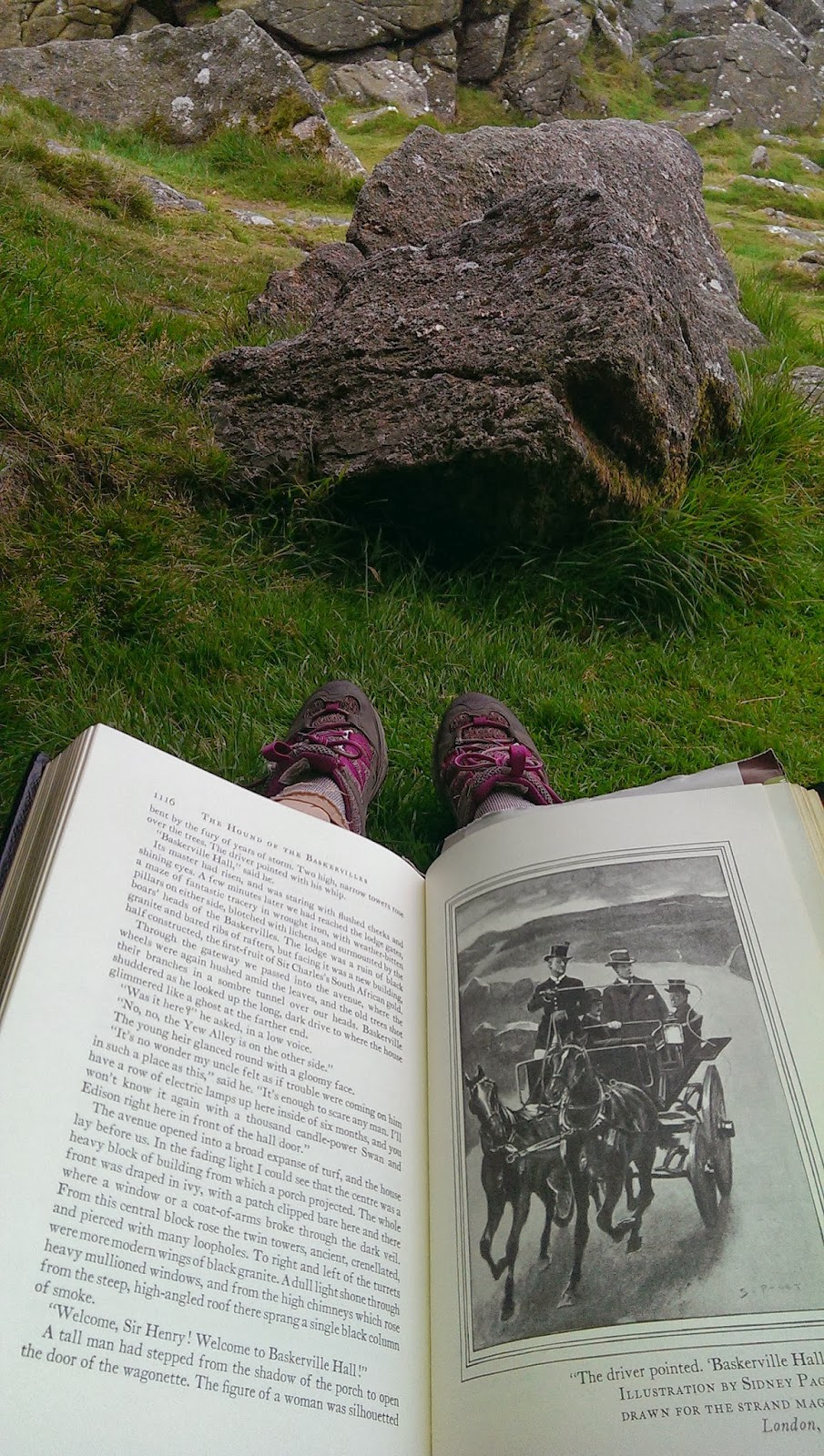
The formations at Hound Tor seemed to jut out from every direction.  The wind continued to blow and the occasional shower came down.  Yes, this is England.  In refuge from the wind and rain, I found shelter among the rocks and decide to read a bit from that famous story and am transported to the 19th Century.

Shelter from the wind and rain and a bit of reading.
"'It is a wonderful place, the moor', said he, looking round over the undulating downs, large green rollers with crests of jagged granite foaming up into fantastic surges.  'You never tire of the moor.  You cannot think the wonderful secrets which it contains.  It is so vast and so barren, and so mysterious'". --The Hound of the Baskervilles
Granite formations on Hound Tor.


"Large green rollers" on Dartmoor


Hayne Downs and Bowerman's Nose
Still the winds blows on day three, as it seems to always blow on my visit to the moor, but this time it was much gentler like a low voice saying hello rather than screaming by ones ears.  My rambles today took me through the tors and formations on Hayne Downs.
Fading morning midst on the formations near Hayne Downs.
 I arrived early enough to see the midst settling upon the highest points, fighting with the sun that eventually came out.  I sat, taking in the view.  I loved it.  Peaceful. Calm.  Beautiful.  Nothing but some moor sheep and an early-risen family out for their walk as well.

I spot Bowerman's Nose, a well-known moor landmark/formation.
Bowerman's Nose in the distance. 
 A legend behind the granite formation tells of a hunter that lived among the moors and came across a group of witches as he and his hounds were hunting a hare, interrupting the ceremony.  As punishment, the next time they hunted upon the moor one witch pretended to be a hare and led them into one of the deadly mires, swamp-like areas, on the moor finally turning them all into stone.
Bowerman's Nose--
see the lovely nose?
The hunter sits on Hayne Down, his large nose prominent; his hounds are among the granite formations on Hound Tor that can resemble dogs.

Midst and sun battle for the day.
As the sun came out in the afternoon, I travelled to a little hamlet in the moor, Widecombe-in-the-Moor, for the local cider and some wifi connection; I did want to get away from the technology, but couldn't do it.  Like Moretonhampton, the town church dates back many centuries and still seems to be the center of life in the small community.  The sun was now out and tourists, like myself, were abound scuttling through the little shops, lounging in the park, and eating in the pubs.  It was a warm and beautiful day after the midst lifted, but in England the weather is an ever-changing thing as evident by the clouds started to gather once again...
Church in Widecombe-in-the-Moor.
Walking around Hayne Downs, I was able to see the remains of another local moor-related story.  I visited Jay's Grave.  While it is only a small mound and headstone, the local story says it is the marking of  the remains of a local girl who committed suicide in the 19th century.  While no one is sure if the story is true, there are always fresh flowers on the grave and no one has ever claimed to know who keeps the grave adorned. There have also been reports of a dark shadow or figure near the grave during the dusk hours of the day...kind of spooky to think about it. More detail on this local story: http://en.wikipedia.org/wiki/Jay%27s_Grave.

Princetown and the attempt to reach Grimpen Mire (or FoxTor Mire):


A view of Princetown from the pathway.
One of the beauties of Dartmoor is its diversity.  One will find woodlands and streams, Tors, rolling hills, and vast expanses of barren, flat, grassy plains...that is the only way I can find to describe the bit of the moor that I explored on this day.  It began from the town of Princetown, an interesting place in itself for this Conan Doyle fan.
The hotel, now a tourist office and local museum, where
Sir Arthur Conan Doyle is said to have stayed during
his time in Princetown. 
  This town certainly had to inspire bits of his work as it is said that he stayed in this building, which is now a tourist centre and local museum.  The city has been the site of a prison since Conan Doyle's time and remains so today.  This fact could have inspired the addition of the wandering prisoner out on the moor who was, at one point, mistaken for Sir Henry Baskerville.

I began my walk from this town and the goal of finding the inspiration for the infamous Grimpen Mire, an area called Fox Tor Mire.  After walking for what seemed to be many, but likely was only a few, miles I sat down to take in the view, the expanse, the quiet.  My solitude was only occasionally interrupted by groups of hikers embarking on the same trail I did, but getting quite further.
The quiet was almost deafening.  I strained my ears for the slightest sound over the remote landscape of this part of Dartmoor.  It seemed like a great grassy desert where, I imagine, if the fog were a little less abundant, I could see for miles.  My plan of heading out to Fox Tor Mires, the inspiration for Grimpen Mires, did not come to fruition this time.  It will have to be for the next time.

Quite in contrast to the previous days, when I searched through the formations for a bit of solitude among the the tour groups and visiting families, this area gives one a feeling of such solitude that the occasional school group or hiker on the path was a welcome sight and chance to say 'hello'.  Not even the wind whistles past my head on this day, simply more of a gentle whisper. Once again some inspiration hits me:

From boulders, to hills and woodlands galore,
That is the beauty that fills Dartmoor.

Old granite quarries, tin-work and medieval stones,
That is the history that fills Dartmoor.

A Hound, a doctor and his friend Mr. Holmes,
Those and many more stories are full of  Dartmoor.

Sheep, cows, and ponies roam free as before,
Free from confinement out on Dartmoor.

The trip back takes me past moorland ponies grazing in the grass.  I notice a mare with its foal and a little further what seemed like an adolescent romping in the grass.  A time for fun and games.
A mare and its foal grazing on Dartmoor

I will return to one of the greatest delights that England has to offer: Dartmoor.  Though perhaps not on my own next time.  Five days

exploring such an amazing place was so delightful that it needs to be shared and continually rediscovered in good company.

Postbridge-Dartmoor


02 October 2013

Dartmoor Delights (Part 1): Need I say more?

My first long-ish holiday since my arrival in the UK was a stop I had dreamed to do for a long time.  I had read descriptions of it, seen pictures of it, and dreamed of walking about its varied landscape.  For five days in August Iwas finally introduced to one of the most beautiful places in the world...in my humble opinion...Dartmoor National Park.

Leaving London an early, dreary Saturday morning I kept an open mind that the clouds would stay centered where they were and as I traveled southwest they might dissipate.  My hopes turned to reality; as I neared Exeter the clouds had cleared and the sun was making its way through. With the sun still shining, I made my way to my first round driving on what I know as the passenger side of a car
My transport in Dartmoor
and driving on the left side of the road.  Needless to say I was apprehensive, but not put off; I'd set my mind to it and me and my little automatic Vauxhall car were off to Dartmoor!

One lesson learned:  GPSs (or Sat Navs in England) suck for getting around in the country.  I should have known better, I'd seen them not work away from urban areas before.  But, an extra £20 got me a SatNav that got me to my destination--the lovely little Devon village of Moretonhampton--via the little back windy country roads...there was surely a more direct way.

The local church in Moretonhampton
Moretonhampton is how one might picture a typical English village.  A medieval church with its cemetery and headstones dating back to the 19th century (as least on those I could read).  Narrow streets wide enough for one.  Several small local pubs where one can grab some food and a pint after a day walking the Moor.  Interactions with locals who know each other and deal with the influx of visitors to their village from the UK and beyond.  I stopped at the tourist information center everyday before beginning to get the weather (and always changing feature on the moor).  They were always helpful, kind and curious as to where I was from--the state of Oregon via London was my response and I was surprised (and not so surprised) to learn that other Oregonians had made their way through Dartmoor as well.  Must be that pioneering spirit.  The five days spent in this quaint small village were as equally captiving and delightful than the Moor itself.
High Street, Moretonhampton

Upon arrival and settling I immediately set out to see what I had traveled all this way too see...the vast beauty I was sure the Dartmoor contained.  I arrived at the first Tor, undoubtedly the most well known, Hay Tor.  Needless to say I was a bit inspired:

I sit by the rocks, out of the moor
With the rushing of the wind
And many grazing sheep.
Blue sky, gray and white, the ceiling
Green grasses, purple and yellow, the floor

I hear the sheep, the birds, never a Hound.
But the jutting rocks and rounded mounds,
Easily tell a different story.

As far as I see, the scene amazes me,
Days of discovery are ahead.
A scene that inspired
Nothing prepares someone for the scene they behold upon arrival into the Hay Tor portion of the Dartmoor. Guide books talked about it and tried to describe it, but nothing can compare to actually rounding the bend and coming upon the sight of the largest rock formation on the Tor.  It is so well recognized that one book likened it to Australia's Ayer's Rock;  I could see why.  I walked among my surroundings and took it all in.

A windy day on Dartmoor.
Rock formations around Hay Tor

"The road in front of us grew bleaker and wilder over huge russet  and olive slopes, sprinkled with granite boulders."-description of Dartmoor by Dr. John Watson in The Hound of the Baskervilles.


The major formation on Hay Tor.  A rock climbers delight.

The moor continued to be an experience the following days.  At Hound Tor the rocks seemed to jut out of the ground from every direction.  The wind continued to blow making me wonder why I bothered to brush my hair that morning.  I wonder if it ever calms down.  I look around and decide to pull out one of the main reasons I came--Sir Arthur Conan Doyle and Sherlock Holmes--and read passages from the great Dartmoor adventure, The Hound of the Baskervilles, over 100 years ago.  It was then sitting in the place about which he wrote and seeing what he was describing.  Every word still describes the moor and it gives Dartmoor a sense of timelessness.

Part 2 to follow...


04 June 2012

Doylian Delights: Doyle's former home--Undershaw--saved from development!

Undershaw Saved!
in Oregon adds its voice to the campaign.
The local Baker Street Irregular scion

At 2:30am on the 30th of May I was still up and, it turns out, it was a good thing because I got to hear the news when those of us on this side of the Atlantic who cared where either tucked away in bed or maybe starting their day. 

A cause that had become important to me a couple of years ago--the preservation of Conan Doyle's residence Undershaw, came to a head last week with a judicial review in London's Royal Courts of Justice. On  April 23 the Undershaw Preservation Trust (UPT), an organization dedicated to preserving the building, went to court to oppose a decision that would grant permission for the property to be split up into nine separate homes.  The Trust was backed and supported by a global campaign of people from around the world who did not want to see the author's home destroyed for future generations.  After a day in court, the judges took the opportunity to delay the decision.  The judgement could have taken as long as two months, but a week later a judgement was announced that planning permission 'must be quashed' because of  'legal flaws' during the process.  

John Gibson, a Conan Doyle scholar who helped found UPT, reacted to the news by saying that it had been a long and difficult battle, but he was thrilled with the decision to 'quash planning permission to redevelop the property'.  

He also said, " Conan Doyle's life and works are a fundamental part of British culture and arguably their stock has never been higher.  We have been absolutely delighted to see enthusiasts from across the world get in touch and pledge their support to our efforts."


What's next?

Now that the permission has been halted, what's next for the Trust and Undershaw?   The Trust continues to work on preservation by submitting an application for an upgrade in status from grade II to grade I.  What does that mean?  According to the Department for Culture, Media, and Sport website,   a grade II buildings are noted as 'special interest'.  It means the building is 'protected against unauthorized demolition, altering or extension', which means if proper channels are taken then it allowed to be changed.  Grade I is a building with 'exceptional interest' and could not be changed under any means. There are several criteria for each listing.  Undershaw has been listed as grade II since 1977.  

The ultimate goal for the property would be to see it preserved as a single building, and as a museum or centre for future generations.  Claude Monet's home at Giverny outside Paris, France, and Horta's home in Brussels, Belgium, have been restored and converted into just such sites of cultural and historic information.  Having visited Giverny myself and being an enthusiat, I would love to see Undershaw preserved and restored in such a fashion.  I would pilgrim to England PDQ to experience the place where Conan Doyle worked, lived and wrote and resurrected perhaps his most (in)famous creation, Sherlock Holmes.  I am happy to have done what I could do (and will continue) for this worthy cause.  Yay, Yay, Yay!


26 April 2012

Doylian Delights Book Review: 'An Entirely New Country' for an entirely worthy cause, Undershaw.

My Introduction to Sir Arthur C. Doyle: 
It was exciting to get this particular book in the mail.  I had a feeling I would enjoy it since my ever-growing Sherlockian tendencies find me reading (even re-reading) most of the canon stories over the last few years.  It did not disappoint.

My first foray into learning more about the creator of Holmes, Sir Arthur Conan Doyle, is through Alistair Duncan's excellent book An Entirely New Country: Arthur Conan Doyle, Undershaw, and the Resurrection of Sherlock Holmes.  Duncan's book, which focuses on the ten-year period Conan Doyle spent at his home Undershaw in Hindhead, Surrey, England, develops a tantalizing timeline of events in Conan Doyle's life in and around Undershaw that shows not only the author, but a potential politician, avid sportsman, and family man.  The years between 1897 and 1907 spent at Undershaw, we learn via Duncan, were full of  activity for both Sherlock Holmes and his creator.

As a reader of Holmes, the most insightful years on the timeline is the year of 1901 and the beginnings of The Hound of the Baskervilles.  Much like today, the phenomena that is Sherlock Holmes continued even after his "death".  The background and ultimate reaction to possibly the most famous adventure was so interesting that I found myself jotting little reactions and notations in the margins.  And it seemed that even more than 100 years later, I was finding similarities between our 21st and early 20th century societies making my read even more extraordinary.  Sherlock's eventual return soon followed in 1903 and '04, which are surely sections of equal interest to Holmes readers.

Leaving 1907 and returning to 2012 left me wanting to learn more about Sir Arthur and the times that he lived.  A recommended read for any fan of Sherlock Holmes, whether one is a recent or longtime fan.  The final pages of the book show Undershaw in its current state:  a rather sad and dilapidated shell of what it once was.  Today, it is in danger of  being torn down and rebuilt into townhouses.  For the past couple years, there has been a great effort to spread the word across England (and the world) in order to save the home.  Duncan's book is part of that effort with proceeds from the book going towards the cause.    

The Cause: Saving Undershaw-the ten-year residence of Sir Arthur Conan Doyle
Undershaw during Conan Doyle's tenure.
This picture can be found in the book. 
One of the things I love about England (and Europe in general) is history.  There is so much to absorb and to imagine.  You could be standing in a street, cathedral/church, house, or sometimes even a pub and be in the midst of history.  Literary history is no exception.  London is filled with Dickens.  Bath has Jane Austen connections.  Undershaw should be part of that literary history.

Noteworthy information :
  • The first design drafts of Undershaw were done by Conan Doyle. 
  • Apart from the house of Thomas Hardy, Undershaw is the only literary house in England that can claim the resident's input in its design.
  • Conan Doyle came up with the name of Undershaw for his new home. 
  •  Undershaw was used a small hotel and restaurant for almost 70 years, where it was visited by many Doyle and Holmes enthusiasts.
The state of Undershaw today: broken and boarded. 
Much has been done to raise awareness over the past couple years.  The Undershaw Preservation Trust was formed and is working hard to fight the plans for development.  Awareness efforts have increased as the date for judicial review gets closer.  Fans and enthusiasts from all over the world are now doing what they can to save the site such as taking photos from various sites all over the world with a message to "Save Undershaw".  In London, local Sherlock fans gathered in Trafalgar Square to inform locals and tourists about the state of Undershaw with great success.

Despite all the efforts there still can be much more to help save this historic, literary site.  Please visit the Undershaw Preservation Trust website for more information on the Trust and Undershaw itself.  

31 July 2011

Deductive Delights: A famous detective's resurgence in the 21st Century-which is best?

It's safe to say that the world's most famous fictional detective, Arthur Conan Doyle's creation, Sherlock Holmes has been amazing the world's population since his inception in the 19th Century.  Readers in Victorian England were appalled when Holmes was "killed" in battle with his foe, Professor James Moriarty that Conan Doyle eventually brought him back.  Since then, Holmes has been present in various forms right up into today.

Confession of a 21st Century Sherlockian: Though I have been aware of the great adventures, I have never become more interested, fascinated, or passionate about Holmes, his "friend and colleague, Dr. Watson", or their adventures until a few years ago.  Since my discovery of the fictional American medical genius Dr. House--a character, whose creator plainly admits was inspired by Sherlock Holmes--I have been intrigued.  However, two of his most recent incarnations definitely may share his name and talent, but actually quite differ from one another.  After this quite long comparison, one will shine through as a clear winner for me, but others can reach their own conclusions.

I want to take a look at both of the current adaptations: one an action-proned sleuth, still set among the handsome cabs and Victorian guise. The other, a young, on-the-edge, self-described sociopath, set in our modern times.  Is one better than the other?  One has to decide for themselves.

Sherlock Holmes: A detective of action


The Sherlock Holmes Warner Bros. movie franchise was introduced to the movie-going public in 2009.  A film directed by Guy Ritchie, starring Robert Downey Jr. as Holmes and Jude Law as Dr. Watson.  The movie saw our protagonists in  the somewhat familiar setting of Victorian London; however, this London was a darker, dirtier and grittier.  It almost seemed to be set within a Dickens novel itself. Perhaps I missed something, but being a reader of both Holmes' adventures and Dickens's novels I never found Conan Doyle's London to be so dark.  It was strange to see the heroes in this London as opposed to the I felt I knew from the Canon and Granada series.  London itself has always been a character just by Holmes' sheer knowledge of every street, however, changing the character of the city seemed to work for this particular interpretation. The story also added supernatural elements and a new foe to the familiarity of characters and places.

London was not the only character to change.  Holmes was transformed from the intellectual, lanky, gentleman to a muscular, action-bound sleuth, while Watson, essentially staying the familiar loyal friend and companion, gave Holmes as good as he got (the anti-thesis of the bumbling Watson from the amazing Basil Rathbone/Nigel Bruce series).  It wasn't easy for me to get used to this more action-mannered Holmes, even though he was known to get in a few fisticuffs in the Canon, but the movie makers created such an interesting way to illustrate Holmes' thinking and process of deduction that I soon accepted this Holmes for what he was...and I liked it.

RDJ, who seemed to pull off a fairly good English accent (at least to the ears of this American, but what would I know), brought to life a new Holmes for a new generation.  Jude Law's Watson continues to return the character to his canonical beginnings.  David Burke along with Edward Hardwicke in the faithful Granada series showed the uniqueness and importance of the friendship to both characters.  The on-screen chemistry between RDJ and Law allows the friendship to shine through quite convincingly.  I will be the first to admit that I love this latest big screen adaptation--having flocked to the theatre in 2009, own the DVD, and will be one of the first in line to see the sequel next December--I can only comment that this interpretation seems to place a more action-seeking, 21st Century Holmes within a dark, 19th Century London.   That, for better or worse, is a combination that spells box office, movie success.

Sherlock:  Canon characters in a modern setting


 This YouTube fan video I decided to post in lieu of a clip or trailer is one way fans  
show their appreciation.  This happens to be one of my favorites highlighting clips of Holmes and Watson's adventures and friendship from the pilot and three episodes of the first series.


Co-creators Mark Gatiss and Steven Moffat have, in many interviews, told the story of the birth of the idea that is the BBC's newest incarnation of Sherlock.  Fans of the show (like myself) will know that the concept, conceived by Gatiss and Moffat on trains between London and Cardiff, of modern day Holmesian adventures taking place in 21st Century London was brought about from the mutual admiration of the Rathbone/Bruce series of films from the late 1930s and early 1940s.  Having now viewed and enjoyed the films that place Holmes and Watson in not only adventures against Moriarty, but also the evils of the second World War, it is no surprise why the newest modern, small screen, television interpretation has garnered the following and accolades in the UK and abroad.

This version asks (and illustrates), as did its creators, why can't Sherlock Holmes and John Watson live and function in a world laced with technology and modern multimedia devices at their fingertips?  In the span of the canon, readers can clearly see Holmes use every modern tool and resources of his time from telegraphs to telephones.  Rathbone and Bruce successfully showed that the friends could exist in the 20th Century with automobiles, now Benedict Cumberbatch and Martin Freeman do the same for television viewers.

With this version, everything is familiar.  London is the large, modern metropolis locals and visitors can recognize from its well-known gathering places like Trafalgar Square to modern-day skyscrapers.  It is a London today's viewers can identify with and understand.  Cumberbatch's Sherlock sends texts rather than telegraphs, uses a computer for research, and has a website.  Similarly, Freeman's John keeps a blog to tell their adventures instead of writing them up for publication.  In this familiar, modern London, it doesn't seem odd at all.  They are modern men in a modern time.

While being modern men, Sherlock and John are still the familiar friends that we know from the original stories.  Sherlock has returned to the tall, lanky, eccentric (who keeps a head in a fridge!), violin-playing man who annoys detectives at (New) Scotland Yard and gets information from London's street population.  While he can still give a good fight, he is not the action man the big screen portrays.  As in the original, John has returned invalided from a new war in Afghanistan and remains the steadfast friend and blogger, while showing his fascination and frustration with his friend. In all versions he exhibits courage in light of their crazy often dangerous adventures.  Cumberbatch and Freeman, two of Britain's hardest working actors, are less known to US audiences which, being a fan of Sherlock and now familiar with their previous work, makes me feel like part of an elite club.  Their on-screen chemistry is second to none save for maybe (and I do stress maybe) Jeremy Brett and Hardwicke.  In fact, I wouldn't be adverse to putting them on equal grounds as the four best actors to have portrayed the friends...granted in two different centuries.

So, what do these two modern, yet different interpretations do for Sherlock Holmes and Dr. John Watson?  No matter which version speaks to a viewer the fact is that it speaks to them.   Viewers of the modern versions and readers of Conan Doyle's adventures enjoyed great stories with great characters. I expect to feel equally shocked when my own Sherlock takes his fall, as implied in the title of the last episode of the next series...The Reichenbach Fall.  But, then again, I can always go back to the silver screen and see another adventure.  Even though neither of these versions fueled my initial resurgence in Holmesian stories, Sherlock is still the modern adventure that speaks to me as it provides a sort of bridge to another time, place and brilliant characters.  Which one can serve as one's own bridge can, in my opinion, only be determined by enjoying both versions.


22 May 2011

Telly Delights: After 152 years a 21st Century re-telling of classic detective stories wins accolades


On the 152nd birthday of Sir Arthur Conan Doyle, creator of the world famous Sherlock Holmes and his loyal friend Dr. John Watson, the 21st century re-telling of the two unlikely friends has garnered two very big British television awards: the BAFTAs.  Sherlock's producing team took home the Best Drama Series award while Dr. John Watson (or as we know him Martin Freeman) was awarded Best Supporting Actor for his role next to Benedict Cumberbatch's brilliant Sherlock.

While the 21st century Watson won an award,  Sherlockian fans lost an icon when Edward Hardwicke (Dr. Watson to the great Jeremy Brett's Holmes) passed away this week.  The Granada series is, with good cause one of the best adaptations of Conan Doyle's original works.  Hardwicke and now Freeman have given the most true interpretations of a wonderfully written character, in my humblest of opinions.

As far as award shows go, beat the Emmys by quite a bit.  And, due to an apparent slip up, the internet is a buzz with the rumor of Cumberbatch joining the Hobbit.  No confirmations or official word, but the buzz is abound nonetheless. 

Article on the BAFTAs