To my delight the great playwright of our day, Mr. William Shakespeare, has written another play! This one is called Hamlet; a tragedy we are all told. The great actor, Richard Burbage, has once again taken the starring role in this piece. I find him to be quite a talented player and am fascinated to see what he is able to do with Mr. Shakespeare's new work. My companion does not, sadly, see this piece in a favourable light. According to her, it appears to be very similar to M. Thomas Kyd's The Spanish Tragedy, which has recently made rounds in the various theatres. 'How?!' I argue. 'A story of revenge, a murder, and even a character named Horatio' begins an answer. I was determined to judge for myself and I am quite content with that decision.
The night of the play we crowded into the dirty and muddy grounds in front of the stage. It has just recently rained and though it is not the most comfortable means, it is certainly an excellent way to view the players: tete a tete, almost. I look around at the other merchants and nobles in the seats above looking down upon us as if we are nothing but lice on a dog, but I take no heed. I am here to see Mr. Burbage and Shakespeare's thrilling new play. The play begins. Watchmen upon the watch see a ghost...the ghost of the murdered King! The drums sound and the ghost appears unwilling to speak unless it is his son, the Prince Hamlet. From there another tale of revenge, madness (real or played, I know not), duality, and even despair and confusion all play their part in this tale.
We, the audience, applauded Burbage, the rest of the players, and Shakespeare himself for this amazing tale of a young prince and his troubled state. ver, depending on the popularity of this play (and I do think it is one of Mr. Shakespeare's best) I wonder how or indeed if an aged Burbage would take this role. The young Burbage of two and thirty years managed to convince me of his university ties. My companion still is not completely convinced of it's differences from Kyd's work, I will endeavour to change their mind. Even the young lad cast as Ophelia put in a great deal of care in conveying the love that was forming for Hamlet and the madness that had overcome her. At a moment, it appeared as Burbage was speaking directly to me as he contemplated life and death...'To be or not be..." that will indeed be the question.

01 January 2014
A year in review: 2013. Discovery of new delights
It was December in London 2012 and on the side of the red, double-decker bus passed me by was the face of Martin Freeman as Bilbo Baggins in an advertisement of The Hobbit. Fast-forward to December 2013, the same, now familiar red, double-deckers pass by with Sir Ian McKellan and a gaggle of dwarves behind him advertising the second installment of this fantasy film. I stopped, agog, looking at it go by...I had been here a year. Never before have I been able to, or have, mark the passage of time by one distinct thing. Yes, a thing. That red bus and the faces of Freeman and McKellan urging me to see a movie. And, thus, began the reflection.
Ok, so this is the time of year we may become reflective. Look upon the past year, make resolutions for the next year. Never have I been inclined to do such things. Now, at the end 2013, I find myself having that sense of reflection. Why? Well, I have had an eventful year, but I have had eventful years in the past. Whatever factors have made me reflective, 2013 has been a year worthy of note, of reflection. Yes, there have been some stressful, bad times, but overall quite memorable and delightful.
As I have mentioned, for an Anglophile, living in the UK (London in particular) can be like hitting the jackpot, and in my case it certainly was. The first few months in a small flat with a not-so-chatty or likable flatmate, forced me out every weekend to walk about and discover my new home.
Walks along rivers have always been a favourite thing of mine--the Willamette, le Rhone et la Soane, the Charles--and having the Thames right at my doorstep (just about literally at that time) was a small blessing during those early months. Walks along the Southbank of the Thames allowed me to discover little gems like Battersea Park, and the Albert Embankment up to Shakespeare's Globe. Public transportation also became my friend as I learned bus routes and Tube lines.
Beginning from Victoria station, I discovered places such as Regent's Park/Primrose Hill and Hampstead Heath, two of best places in all of London, and rest of city bits I now navigate with utter confidence.
I continue to discover new areas (Couch End and Kensington, for example), but the favs are still favs and often revisited.
London has also allowed my fancy as a theatre-goer to flourish and grow. I had seen great London performances of Frankenstein and The Curious Incident in the Night Time via the National Theatre Live (NT Live) in the US and was able to review both plays, however, it is a different experience all together seeing the actual piece. From my first attendance of Uncle Vanya at the Vaudeville Theatre on The Strand, I was hooked. Seeing the likes of actors like Ken Stott and Laura Carmichal to Mark Gatiss and Tom Hiddleston on stage rather than on film or TV cannot be matched. One realizes the talent and work that goes into the craft in a stage performance, and it is a priviledge to be in a city where not only new and growing actors, but established, well-known ones grace the stage. It was indeed my intention to write reviews of each excellent play I have seen over the past year, but alas, life has gotten in the way. There aren't enough hours in the day. Therefore, reviews for the likes of plays such as The Tempest, MacBeth, As You Like It, Jeeves and Wooster: Perfect Nonsense, Coriolanus, and Richard II, have been delayed.
I've also expanded my musical taste and found new sounds to delight in. The emerging and expanding, I might call it, genres of folk, country and americana, has also taken hold in England. I discovered a fantastic little club in Camden called the Green Note, where they feature live jazz, world, blues and folk music. I have enjoyed many a gig there and have discovered the wonderful sounds of Hatful of Rain, Jamie Freeman Agreement, The Self Help Group, Maz O'Conner, and Emily Baker.
Last, but certainly not least, is the wonderful new people I have met in 2013 stemming from joining the Sherlock Holmes Society of London. This society has a range of Holmes fans spanning from those who have been Holmesians for years to recent Sherlockians, and hitting many generations and age ranges: the power of the great detective to span several generations and hundreds of years. How many figures, fictional or not, can do that?! Society gatherings have allowed me to meet some
wonderful people who's interest and passion for all things Holmesian is as large (sometimes larger) than my own.
2013 has definitely been a memorable year. Here's to 2014 being just as, and with any luck more, eventful and memorable as the previous one!
Next year, will be the third (and last) Hobbit advertisements to appear on the side of the London buses. I wonder what kind of delightful things I will have done and discovered by then. Bring it on!
Ok, so this is the time of year we may become reflective. Look upon the past year, make resolutions for the next year. Never have I been inclined to do such things. Now, at the end 2013, I find myself having that sense of reflection. Why? Well, I have had an eventful year, but I have had eventful years in the past. Whatever factors have made me reflective, 2013 has been a year worthy of note, of reflection. Yes, there have been some stressful, bad times, but overall quite memorable and delightful.
As I have mentioned, for an Anglophile, living in the UK (London in particular) can be like hitting the jackpot, and in my case it certainly was. The first few months in a small flat with a not-so-chatty or likable flatmate, forced me out every weekend to walk about and discover my new home.
 |
| The Southbank of the Thames on my walk to work |
 |
| Regent's Park on a sunny day |
 |
| Hampstead Heath in the Fall |
London has also allowed my fancy as a theatre-goer to flourish and grow. I had seen great London performances of Frankenstein and The Curious Incident in the Night Time via the National Theatre Live (NT Live) in the US and was able to review both plays, however, it is a different experience all together seeing the actual piece. From my first attendance of Uncle Vanya at the Vaudeville Theatre on The Strand, I was hooked. Seeing the likes of actors like Ken Stott and Laura Carmichal to Mark Gatiss and Tom Hiddleston on stage rather than on film or TV cannot be matched. One realizes the talent and work that goes into the craft in a stage performance, and it is a priviledge to be in a city where not only new and growing actors, but established, well-known ones grace the stage. It was indeed my intention to write reviews of each excellent play I have seen over the past year, but alas, life has gotten in the way. There aren't enough hours in the day. Therefore, reviews for the likes of plays such as The Tempest, MacBeth, As You Like It, Jeeves and Wooster: Perfect Nonsense, Coriolanus, and Richard II, have been delayed.
 |
| Union Music Store in Lewes |
Last, but certainly not least, is the wonderful new people I have met in 2013 stemming from joining the Sherlock Holmes Society of London. This society has a range of Holmes fans spanning from those who have been Holmesians for years to recent Sherlockians, and hitting many generations and age ranges: the power of the great detective to span several generations and hundreds of years. How many figures, fictional or not, can do that?! Society gatherings have allowed me to meet some
 |
| Travels along the Thames with the Sherlock Holmes Society of London |
2013 has definitely been a memorable year. Here's to 2014 being just as, and with any luck more, eventful and memorable as the previous one!
Next year, will be the third (and last) Hobbit advertisements to appear on the side of the London buses. I wonder what kind of delightful things I will have done and discovered by then. Bring it on!
19 October 2013
Debating delights: Are we The Fifth Estate? (review)
How much should we know? Is there a line between transparency and privacy? Can there be too much information?
The opening titles to the film The Fifth Estate take the viewer through the evolution of communication. It begins with stone and a tool and takes us through all forms of communication from the written letter, printed page, telegraph, a typewriter, wireless radio, television, computers, the internet and everything else in between. This was a title sequence I wasn't expecting and for a moment I thought I was in the wrong screening room until I saw the name I was expecting to see...in all honesty, the initial reason I went to see the film was because one of the main characters, website founder Julian Assange, was being interpreted by Benedict Cumberbatch, and in any other circumstance this reason alone would be a good enough reason for me to see something. However, coming to that decision for this film was something in itself. In the end, I was glad that I made the one I did.
The media frenzy that surrounded the release, and indeed making, of the film is no surprise. It is timely. It depicts a story of real people who made a significant change to our society. And, it is a story that continues.
I had seen the stories on the news and heard about information that whistleblowers provided to the website, Wikileaks; however, those things can seem a world away from an average Jane, like me. We are all consumed by our own world: our work, our family, our friends, our interests, our problems. Therefore, the in and outs of this phenomena were foreign to me, so before rushing out to see a movie with one of my favourite actors I took a few steps that I normally wouldn't before seeing a film.
First, I read and paid attention to reviews. Those I read seemed to be saying the same thing: brilliant acting by Cumberbatch (I already expected that), but a weak script and overall story. Hmmm, I thought, a story is very important to me maybe it won't be worth it. However, as interviews began making their way to the press, it was clear one of the main characters in the story itself, Assange, was against the film and had communicated this to the actor about to portray him. This also made me stop and think...why would one of the main figures be against the story? Again, listening to both sides made the difference. As much as the argument against the movie was convincing, Cumberbatch's response and reason for doing it was just as intriguing and viable argument, in my mind. So, with mixed reviews from critics and two opposing thoughts from the man and his portrayer, I went to see it.
Many reviews have compared The Fifth Estate, for better or worse, to The Social Network. Having not seen that movie, I cannot make that comparison. The stories, in general, appear to be similar so I can see where the comparison comes to play, but I can't comment directly. The Fifth Estate is a visually impressive film. The use of colour and lightening makes it a really pretty film. This combined with the quick-paced editing, text popping up on the screen (a la BBC Sherlock to me), and an equally fast paced, thumping, memorable soundtrack makes for an enjoyable movie-going experience. As mentioned, the performances from all players is perhaps the strongest part of the film. Cumberbatch and Daniel Bruhl give commanding performances in the role of the two major characters. Even smaller roles such as Guardian journalists played by Dan Stevens (of Downton Abbey fame), Peter Capaldi (best known for The Thick of It and soon taking the role of the 12th Doctor Who), and David Thewlis (Harry Potter's Professor Lupin) make brief, but memorable contributions. But, yes, the story itself felt disjointed and lumpy. Even though the lovely on-screen text continually shows the viewer where they are in the world--from London to Africa to Berlin and Liege--the story brings in bits of other pieces such as Manning and US government officials, but leaves the viewer hanging...perhaps because these pieces are still unfinished...as is the whole story.
In the end, The Fifth Estate is a film--a story from one particular perspective and interpreted by actors. It is not a documentary about Wikileaks. It isn't a biopic about Julian Assange. These are important factors to keep in mind. I didn't go into it expecting to learn all there was about Wikileaks or its founder. I went to see a film with excellent actors, commenting on a timely and important subject in our society: that is what I got. It is a film worth seeing, but you have to know what you want to get from it because it can go both ways--much like many of the important issues in our society. I certainly got me thinking...
 |
| Fifth Estate poster in the London Underground |
The media frenzy that surrounded the release, and indeed making, of the film is no surprise. It is timely. It depicts a story of real people who made a significant change to our society. And, it is a story that continues.
I had seen the stories on the news and heard about information that whistleblowers provided to the website, Wikileaks; however, those things can seem a world away from an average Jane, like me. We are all consumed by our own world: our work, our family, our friends, our interests, our problems. Therefore, the in and outs of this phenomena were foreign to me, so before rushing out to see a movie with one of my favourite actors I took a few steps that I normally wouldn't before seeing a film.
First, I read and paid attention to reviews. Those I read seemed to be saying the same thing: brilliant acting by Cumberbatch (I already expected that), but a weak script and overall story. Hmmm, I thought, a story is very important to me maybe it won't be worth it. However, as interviews began making their way to the press, it was clear one of the main characters in the story itself, Assange, was against the film and had communicated this to the actor about to portray him. This also made me stop and think...why would one of the main figures be against the story? Again, listening to both sides made the difference. As much as the argument against the movie was convincing, Cumberbatch's response and reason for doing it was just as intriguing and viable argument, in my mind. So, with mixed reviews from critics and two opposing thoughts from the man and his portrayer, I went to see it.
Many reviews have compared The Fifth Estate, for better or worse, to The Social Network. Having not seen that movie, I cannot make that comparison. The stories, in general, appear to be similar so I can see where the comparison comes to play, but I can't comment directly. The Fifth Estate is a visually impressive film. The use of colour and lightening makes it a really pretty film. This combined with the quick-paced editing, text popping up on the screen (a la BBC Sherlock to me), and an equally fast paced, thumping, memorable soundtrack makes for an enjoyable movie-going experience. As mentioned, the performances from all players is perhaps the strongest part of the film. Cumberbatch and Daniel Bruhl give commanding performances in the role of the two major characters. Even smaller roles such as Guardian journalists played by Dan Stevens (of Downton Abbey fame), Peter Capaldi (best known for The Thick of It and soon taking the role of the 12th Doctor Who), and David Thewlis (Harry Potter's Professor Lupin) make brief, but memorable contributions. But, yes, the story itself felt disjointed and lumpy. Even though the lovely on-screen text continually shows the viewer where they are in the world--from London to Africa to Berlin and Liege--the story brings in bits of other pieces such as Manning and US government officials, but leaves the viewer hanging...perhaps because these pieces are still unfinished...as is the whole story.
In the end, The Fifth Estate is a film--a story from one particular perspective and interpreted by actors. It is not a documentary about Wikileaks. It isn't a biopic about Julian Assange. These are important factors to keep in mind. I didn't go into it expecting to learn all there was about Wikileaks or its founder. I went to see a film with excellent actors, commenting on a timely and important subject in our society: that is what I got. It is a film worth seeing, but you have to know what you want to get from it because it can go both ways--much like many of the important issues in our society. I certainly got me thinking...
06 October 2013
Dartmoor Delights (Part 2): Indeed, I will say more.
 |
| Hound Tor from afar. |
Guide books outlined walks and sights, but I found, when the guides ended up being a tad confusing to me, my own explorations and walks suited just as well. I wandered about the rock forms, down to the remains of a medieval settlement and through the flora.
 |
| Medieval settlement remains with Hound Tor in the distance. |
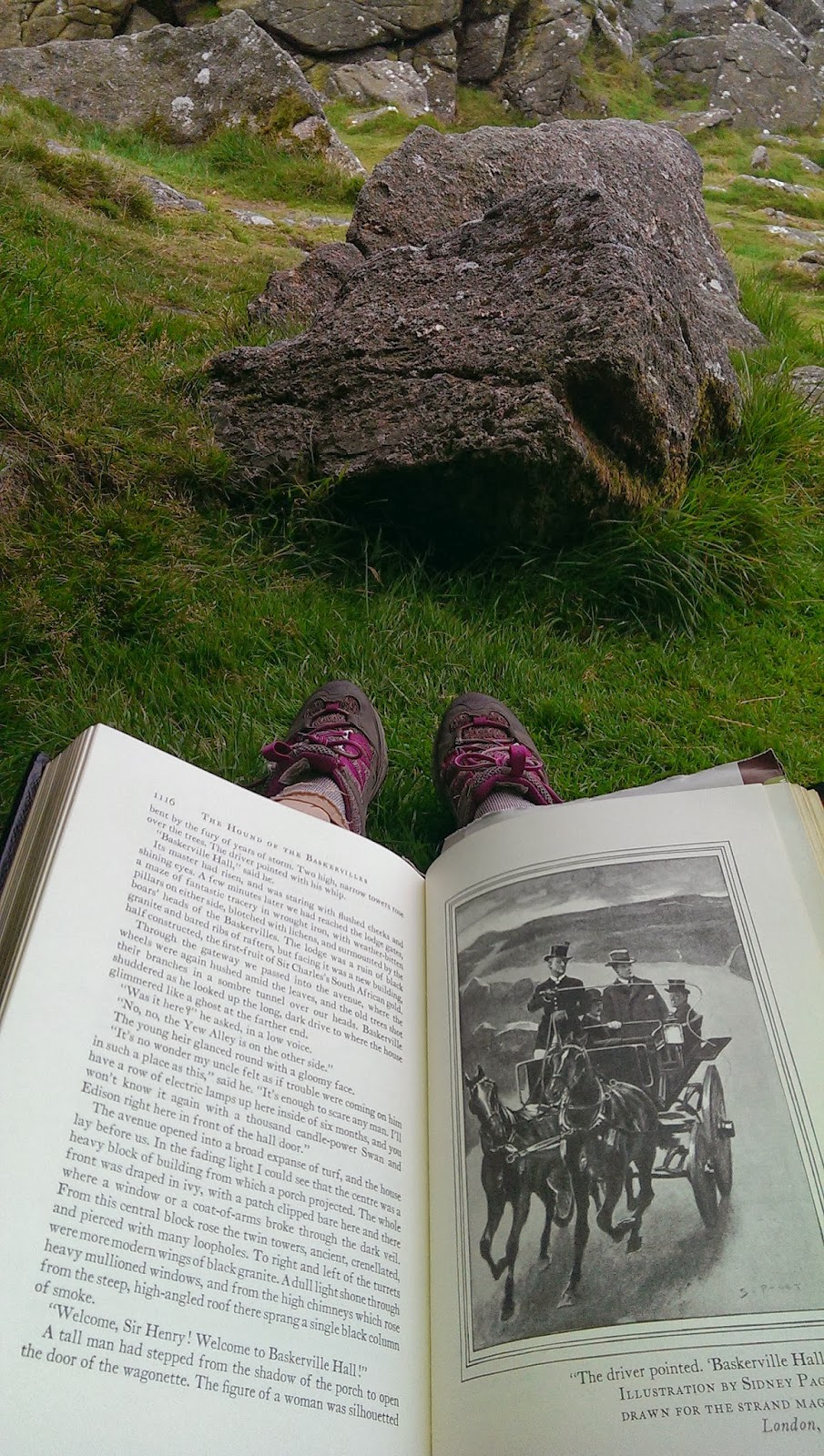 |
| Shelter from the wind and rain and a bit of reading. |
 |
| Granite formations on Hound Tor. |
 |
| "Large green rollers" on Dartmoor |
Hayne Downs and Bowerman's Nose
Still the winds blows on day three, as it seems to always blow on my visit to the moor, but this time it was much gentler like a low voice saying hello rather than screaming by ones ears. My rambles today took me through the tors and formations on Hayne Downs.
 |
| Fading morning midst on the formations near Hayne Downs. |
I spot Bowerman's Nose, a well-known moor landmark/formation.
 |
| Bowerman's Nose in the distance. |
 |
| Bowerman's Nose-- see the lovely nose? |
 |
| Midst and sun battle for the day. |

 |
| Church in Widecombe-in-the-Moor. |
Princetown and the attempt to reach Grimpen Mire (or FoxTor Mire):
 |
| A view of Princetown from the pathway. |
 |
| The hotel, now a tourist office and local museum, where Sir Arthur Conan Doyle is said to have stayed during his time in Princetown. |
I began my walk from this town and the goal of finding the inspiration for the infamous Grimpen Mire, an area called Fox Tor Mire. After walking for what seemed to be many, but likely was only a few, miles I sat down to take in the view, the expanse, the quiet. My solitude was only occasionally interrupted by groups of hikers embarking on the same trail I did, but getting quite further.

Quite in contrast to the previous days, when I searched through the formations for a bit of solitude among the the tour groups and visiting families, this area gives one a feeling of such solitude that the occasional school group or hiker on the path was a welcome sight and chance to say 'hello'. Not even the wind whistles past my head on this day, simply more of a gentle whisper. Once again some inspiration hits me:
From boulders, to hills and woodlands galore,
That is the beauty that fills Dartmoor.

Old granite quarries, tin-work and medieval stones,
That is the history that fills Dartmoor.
A Hound, a doctor and his friend Mr. Holmes,
Those and many more stories are full of Dartmoor.
Sheep, cows, and ponies roam free as before,
Free from confinement out on Dartmoor.
The trip back takes me past moorland ponies grazing in the grass. I notice a mare with its foal and a little further what seemed like an adolescent romping in the grass. A time for fun and games.
 |
| A mare and its foal grazing on Dartmoor |
I will return to one of the greatest delights that England has to offer: Dartmoor. Though perhaps not on my own next time. Five days

 |
| Postbridge-Dartmoor |

02 October 2013
Dartmoor Delights (Part 1): Need I say more?
My first long-ish holiday since my arrival in the UK was a stop I had dreamed to do for a long time. I had read descriptions of it, seen pictures of it, and dreamed of walking about its varied landscape. For five days in August Iwas finally introduced to one of the most beautiful places in the world...in my humble opinion...Dartmoor National Park.
Leaving London an early, dreary Saturday morning I kept an open mind that the clouds would stay centered where they were and as I traveled southwest they might dissipate. My hopes turned to reality; as I neared Exeter the clouds had cleared and the sun was making its way through. With the sun still shining, I made my way to my first round driving on what I know as the passenger side of a car
and driving on the left side of the road. Needless to say I was apprehensive, but not put off; I'd set my mind to it and me and my little automatic Vauxhall car were off to Dartmoor!
One lesson learned: GPSs (or Sat Navs in England) suck for getting around in the country. I should have known better, I'd seen them not work away from urban areas before. But, an extra £20 got me a SatNav that got me to my destination--the lovely little Devon village of Moretonhampton--via the little back windy country roads...there was surely a more direct way.
Moretonhampton is how one might picture a typical English village. A medieval church with its cemetery and headstones dating back to the 19th century (as least on those I could read). Narrow streets wide enough for one. Several small local pubs where one can grab some food and a pint after a day walking the Moor. Interactions with locals who know each other and deal with the influx of visitors to their village from the UK and beyond. I stopped at the tourist information center everyday before beginning to get the weather (and always changing feature on the moor). They were always helpful, kind and curious as to where I was from--the state of Oregon via London was my response and I was surprised (and not so surprised) to learn that other Oregonians had made their way through Dartmoor as well. Must be that pioneering spirit. The five days spent in this quaint small village were as equally captiving and delightful than the Moor itself.
Upon arrival and settling I immediately set out to see what I had traveled all this way too see...the vast beauty I was sure the Dartmoor contained. I arrived at the first Tor, undoubtedly the most well known, Hay Tor. Needless to say I was a bit inspired:
I sit by the rocks, out of the moor
With the rushing of the wind
And many grazing sheep.
Blue sky, gray and white, the ceiling
Green grasses, purple and yellow, the floor
I hear the sheep, the birds, never a Hound.
But the jutting rocks and rounded mounds,
Easily tell a different story.
As far as I see, the scene amazes me,
Days of discovery are ahead.
Nothing prepares someone for the scene they behold upon arrival into the Hay Tor portion of the Dartmoor. Guide books talked about it and tried to describe it, but nothing can compare to actually rounding the bend and coming upon the sight of the largest rock formation on the Tor. It is so well recognized that one book likened it to Australia's Ayer's Rock; I could see why. I walked among my surroundings and took it all in.
The moor continued to be an experience the following days. At Hound Tor the rocks seemed to jut out of the ground from every direction. The wind continued to blow making me wonder why I bothered to brush my hair that morning. I wonder if it ever calms down. I look around and decide to pull out one of the main reasons I came--Sir Arthur Conan Doyle and Sherlock Holmes--and read passages from the great Dartmoor adventure, The Hound of the Baskervilles, over 100 years ago. It was then sitting in the place about which he wrote and seeing what he was describing. Every word still describes the moor and it gives Dartmoor a sense of timelessness.
Leaving London an early, dreary Saturday morning I kept an open mind that the clouds would stay centered where they were and as I traveled southwest they might dissipate. My hopes turned to reality; as I neared Exeter the clouds had cleared and the sun was making its way through. With the sun still shining, I made my way to my first round driving on what I know as the passenger side of a car
 |
| My transport in Dartmoor |
One lesson learned: GPSs (or Sat Navs in England) suck for getting around in the country. I should have known better, I'd seen them not work away from urban areas before. But, an extra £20 got me a SatNav that got me to my destination--the lovely little Devon village of Moretonhampton--via the little back windy country roads...there was surely a more direct way.
 |
| The local church in Moretonhampton |
 |
| High Street, Moretonhampton |
Upon arrival and settling I immediately set out to see what I had traveled all this way too see...the vast beauty I was sure the Dartmoor contained. I arrived at the first Tor, undoubtedly the most well known, Hay Tor. Needless to say I was a bit inspired:
I sit by the rocks, out of the moor
With the rushing of the wind
And many grazing sheep.
Blue sky, gray and white, the ceiling
Green grasses, purple and yellow, the floor
I hear the sheep, the birds, never a Hound.
But the jutting rocks and rounded mounds,
Easily tell a different story.
As far as I see, the scene amazes me,
Days of discovery are ahead.
 |
| A scene that inspired |
 |
| A windy day on Dartmoor. |
 |
| Rock formations around Hay Tor |
 |
| "The road in front of us grew bleaker and wilder over huge russet and olive slopes, sprinkled with granite boulders."-description of Dartmoor by Dr. John Watson in The Hound of the Baskervilles. |
 |
| The major formation on Hay Tor. A rock climbers delight. |
The moor continued to be an experience the following days. At Hound Tor the rocks seemed to jut out of the ground from every direction. The wind continued to blow making me wonder why I bothered to brush my hair that morning. I wonder if it ever calms down. I look around and decide to pull out one of the main reasons I came--Sir Arthur Conan Doyle and Sherlock Holmes--and read passages from the great Dartmoor adventure, The Hound of the Baskervilles, over 100 years ago. It was then sitting in the place about which he wrote and seeing what he was describing. Every word still describes the moor and it gives Dartmoor a sense of timelessness.
Part 2 to follow...
Subscribe to:
Posts (Atom)